
Every warranty claim your dealership submits is one small mistake away from a denial. A missing tech punch time. The wrong op code. A service tech that doesn’t match the job. Individually, these look like nothing. To a manufacturer, any one of them is enough to reject the claim outright, and now that repair order is sitting unpaid, aging on your schedule, waiting on a resubmission that eats your admin’s time.
If you run a service department, you already know this. The real question isn’t whether denials happen, it’s how many are quietly costing you money every month, and whether the person filing them has the time and expertise to catch every detail before submission. This guide breaks down why claims get denied, what a denial actually costs you once you account for the downstream work, and the specific steps that keep your first-submission rate high.

What counts as a denied warranty claim?
A denied warranty claim is any repair order the manufacturer refuses to pay as submitted. In practice, denials come in a few flavors, and it helps to separate them because they don’t all cost the same or get fixed the same way.
A chargeback is different, it’s money the manufacturer already paid you, then took back later during an audit because the documentation didn’t hold up after the fact.
A chargeback is the one that stings the most, because it hits your schedule months after you thought the claim was closed. A clean submission process protects you, the dealer, but chargebacks are the clearest argument for getting the details right the first time rather than hoping a thin claim slips through.
Why do dealership warranty claims get denied?
Most denials don’t always come from big, obvious errors. They come from small ones that slip past a busy admin juggling a full board. Here are the most common culprits, and why each one stops payment.
1. Incorrect or missing LOP codes
Every manufacturer has unique Labor-OP requirements, and they change. Select the wrong operation code, or miss the additional code that captures the full scope of a repair, and the claim either gets denied or pays out at a fraction of what it should. Op code accuracy is one of the single biggest drivers of both denials and under-reimbursement.
The trap is that op codes feel like a solved problem. An admin who has filed a thousand oil-change claims stops double-checking the code and starts working from muscle memory. But the moment a repair is even slightly non-standard, a diagnostic that turned into a component replacement, a job that touched two systems, the muscle-memory code is wrong, and the claim is either denied or quietly underpaid. Multiply that across a month and the underpayment alone is real money.
2. Service technicians that don’t match the job
If the labor operation, the parts used, and the technician’s story on the repair order don’t line up the way the manufacturer expects, the claim gets flagged. A perfectly valid repair can be rejected simply because the documentation doesn’t support the way it was submitted. Manufacturers are increasingly cross-checking the parts on the claim against the labor operation billed, if a labor op implies a part that isn’t on the claim, or a part appears with no corresponding labor, that mismatch is an automatic flag.
3. Missing tech punch time or clocking detail
Manufacturers increasingly require proof of actual time on the job. No punch detail, insufficient clocking time, or straight time that was never properly authorized, and the claim stalls, no matter how legitimate the work. This is where a lot of diagnostic and straight-time dollars quietly disappear: the technician did the work, but without the punch detail to back it up, the time is unclaimable and simply written off.
4. Incomplete documentation
This is the quiet killer. A missing rental invoice. Undocumented sublet work. A diagnostic sheet that never got attached. An incomplete condition-cause-correction narrative. Each one is small, common, and entirely avoidable, and each one is enough to hold up payment. The 3 C’s in particular are a frequent failure point: if the correction doesn’t clearly tie back to the customer’s stated condition and the technician’s diagnosed cause, the manufacturer has grounds to question the whole repair.
5. Missed brand-specific requirements
Beyond the universals above, every manufacturer layers on its own rules, requiring photos for certain repairs, specific narrative formats, mandatory fields, particular handling for recalls versus standard warranty. What passes clean for one brand gets flagged for another. A dealership carrying multiple franchises is effectively running several different rulebooks at once, and keeping all of them straight is a genuine, ongoing burden.
What a denied claim actually costs your department
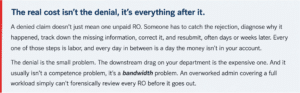
It’s tempting to think of a denial as a delay rather than a loss, you’ll fix it and resubmit, so eventually you get paid. But that framing hides the real cost, which shows up in four places:
- Rework labor. Catching the denial, diagnosing it, gathering the missing detail, and resubmitting is pure administrative overhead, time your admin spends re-doing a claim instead of processing new ones.
- Delayed cash flow. A claim that should have paid in two days now pays in three or four weeks. Across a full schedule, that lag ties up meaningful money.
- Aging and write-offs. Denied claims that don’t get resubmitted quickly age on your schedule, and claims that age past manufacturer limits get written off entirely, a total loss on work your techs already performed.
- Audit exposure. A pattern of thin, error-prone submissions raises your risk of a manufacturer audit, and audits are where soft approvals turn into chargebacks.
Put together, a 20-point gap in first-submission approval rate, the difference between a typical ~80% and a well-run 97%+, isn’t a rounding error. On a busy warranty schedule it’s a steady, compounding leak in your department’s gross.
Denial vs. chargeback: what’s the difference?
A denial happens before payment, the manufacturer declines the claim, so you never receive the money. A chargeback happens after payment, the manufacturer paid the claim, then reclaimed the funds later, usually during a warranty audit, because something in the documentation didn’t support the payment. Denials hurt your cash flow in the moment. Chargebacks hurt worse, because they hit unpredictably and often in bulk, clawing back months of claims at once. Both come down to the same root cause: submissions that weren’t airtight when they went out. Preventing denials and preventing chargebacks is the same discipline, review everything before it’s submitted.
How to prevent warranty claim denials
The only reliable way to reduce denials is to catch the problems before submission, not after. That means every repair order gets checked for:
- Correct, brand-specific lop code selection
- Alignment between the labor operation, parts, and technician narrative
- Complete tech punch time and clocking detail
- Full documentation, rental, sublet, diagnostic sheets, complete 3 C’s
- Verified coverage against time and mileage limits
- Each manufacturer’s brand-specific fields, photos, and narrative requirements
Doing that consistently, on every claim, is exactly what an overloaded in-house admin can’t guarantee, and exactly what a dedicated warranty team is built to do. The difference isn’t that a specialist knows some secret the admin doesn’t; it’s that reviewing every RO with fresh eyes, before it’s submitted, is their whole job rather than one more task competing with a full board.
Why bandwidth, not skill, is the real problem
It’s worth being clear about this, because it’s the heart of the issue. Most denied claims aren’t filed by bad administrators. They’re filed by good administrators who are stretched too thin, covering a full warranty schedule, fielding questions from advisors and techs, keeping up with shifting brand requirements, and trying to submit fast enough to keep cash flowing. Under that load, the careful pre-submission review is the first thing to get compressed, because it’s the step with no immediate deadline attached.
Then the admin takes a vacation, gets sick, or leaves for another job, and the claims stop entirely, or get handed to someone with even less time and context. The denials that follow aren’t a skills gap. They’re a structural one. Any process that depends on a single overloaded person having enough hours in the day is going to leak claims, no matter how good that person is.
What a denial-proof claims process looks like end to end
Preventing denials isn’t a single check, it’s a disciplined sequence applied to every repair order, every day. A process built to keep your first-submission rate high generally runs like this:
- Daily intake. Every RO invoiced the previous day enters the queue the next business day, no batching, no letting claims sit until someone has time.
- Pre-submission review. Each claim is checked against the denial triggers above: op code accuracy, labor-to-parts alignment, punch detail, documentation, coverage, and brand-specific requirements.
- Flag and resolve. Anything missing is routed back to the dealership through a live shared document, so gaps are closed before submission rather than discovered after a rejection.
- Submit clean. Only fully vetted claims go to the manufacturer, which is what drives a first-pass approval rate in the high-90s instead of the low-80s.
- Reconcile and monitor. Credit memos are posted as funds release, and the schedule is audited so nothing ages past 30 days or quietly falls through the cracks.
The point of laying it out this way is simple: none of these steps is exotic. They’re all things a diligent admin would do with unlimited time. The reason denials happen is that no in-house admin has unlimited time, so the review steps are the ones that get compressed. A process that guarantees every step on every claim is the whole game.
How QB Business Solutions prevents denials before they happen
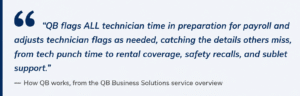
QB reviews and vets every repair order before it’s submitted, checking for the specific details that get claims denied, op codes, service mechanic alignment, tech punch detail, documentation completeness, coverage verification, and each brand’s particular requirements. When something’s missing, we flag it and route it back to your team through a live shared document so it’s fixed before submission, not after a rejection. Because we operate as a team rather than a single admin, that review happens on every claim, every day, including the days your own staff would be out.
The result is a first-submission approval rate of 97% or above, compared to a typical dealership rate around 80%, which means faster payment, fewer resubmissions, less audit exposure, and a service department that isn’t spending the month chasing denied claims.