
On paper, keeping warranty claims in-house looks like the economical choice, you pay one salary and the work gets done. But that math only holds if your admin never gets sick, never takes vacation, never quits, never falls behind, and never miscodes a claim. In a real service department, all of those happen, and each one carries a cost that never appears on the salary line.
The right question isn’t “what does a warranty admin cost?” It’s “what is my current claims process costing me in denied claims, aging schedule, and downtime when one person is out?” This guide breaks down the true cost of each model, the point at which outsourcing starts to make sense, and the signs that your in-house setup is quietly losing you money.

The true cost of an in-house warranty admin
The salary line is the part everyone sees. The real cost of running claims in-house is the sum of everything underneath it, and most of that never makes it onto a budget.
Salary is only the starting point
A qualified warranty administrator commands a full-time salary plus benefits, payroll taxes, and the management overhead of another employee, all to have one person doing one job, with no redundancy behind them. And a genuinely experienced warranty admin, one who knows multiple brands cold, is not cheap and not easy to find. The better they are, the more they cost and the more damage their departure does.
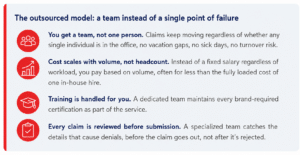
Turnover stops your claims cold
Warranty admin is a high-turnover role. When yours leaves, your claims don’t pause and wait for a replacement, they pile up. Now you’re paying to recruit, hire, and train someone new while unsubmitted repair orders age on your schedule and your cash flow slows. Industry hiring data consistently shows service-department roles among the hardest to keep filled, and every gap between one admin leaving and the next getting up to speed is a stretch where claims either stall or get filed by someone who doesn’t yet know your brands’ requirements.
The learning curve is its own hidden cost
Even once you’ve hired a replacement, they’re not immediately effective. A new warranty admin has to learn your DMS setup, your brands’ specific requirements, your advisors’ documentation habits, and the quirks of your schedule. During that ramp, which can run weeks to months, denial rates climb and submission speed drops. You’re paying a full salary for partial output, and paying again in the denied claims that ramp produces.
Absence creates gaps with no backup
Every day your admin is on vacation, out sick, or otherwise unavailable is a day claims aren’t moving. With a single point of failure, there’s no continuity, just a backlog someone has to dig out of later. A one-week vacation isn’t one week of delay; it’s a backlog that takes additional time to clear on top of the normal daily volume once they’re back.
Training and compliance are your burden to carry
Every brand has its own warranty requirements and required certifications, and they change. Keeping one in-house admin current across every brand you carry is an ongoing time and cost commitment that lands on you, and if a certification lapses, claims for that brand are at risk until it’s restored.
Errors are the largest hidden expense of all
An admin juggling a full board will miss things, a wrong lop code, a missing punch time, incomplete documentation. Each miss is a denied claim, a chargeback risk, and a resubmission that eats hours. The salary is fixed; the cost of the errors is not, and it scales with how overloaded the person is. The busier your shop gets, exactly when warranty volume is highest, the more corners get cut and the more the error cost climbs.
In-house vs. outsourced: a side-by-side comparison
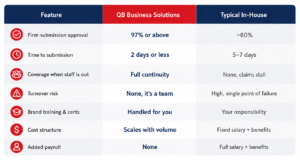
A higher first-submission rate means faster payment and fewer resubmissions. Faster turnaround means healthier cash flow. Continuity means your warranty revenue no longer depends on whether one person shows up to work. And a volume-based cost means you’re not paying a fixed salary through the slow months to be ready for the busy ones.
Signs it’s time to outsource your warranty claims
You don’t need every one of these to be true, but if several sound familiar, your in-house setup is likely costing you more than it appears:
- Your claims noticeably back up whenever your admin is on vacation or out sick.
- Your first-submission approval rate is below the mid-90s, or you don’t track it closely enough to know.
- You’ve had warranty-admin turnover in the last year or two, and felt the disruption.
- You carry multiple franchises and struggle to keep every brand’s requirements straight.
- Claims regularly age past 30 days on your schedule.
- You’ve been hit with chargebacks after a manufacturer audit.
- Your admin spends so much time on claims that other fixed-ops work suffers.
Each of these points to the same underlying issue: a claims process that depends on one overloaded person, with no redundancy when that person is stretched, absent, or gone.
When does keeping it in-house make sense?
To be fair, in-house isn’t always the wrong answer. It can be the right call when you have the volume to fully justify a dedicated admin, the bandwidth to manage their training and turnover, a strong and stable performer already in the seat, and the tolerance for coverage gaps when they’re out. Some large, single-franchise stores with a long-tenured admin run a tight in-house operation and have little reason to change.
For most dealerships, though, especially multi-brand stores, stores that have felt turnover, and stores where the admin is clearly stretched, the outsourced model delivers higher approval rates, faster submissions, and full continuity for less than the true, fully loaded cost of keeping it in-house.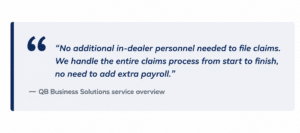
How QB Business Solutions handles it
QB processes your entire warranty claims workflow from start to finish, with a 97%+ first-submission rate, 2-day turnaround, and zero added payroll. Every RO invoiced the previous day is processed the next business day. Every claim is reviewed and vetted for brand compliance before it’s submitted. And because we work as a team, your claims never stop, not for vacations, not for illness, not for turnover. Your people stay focused on the shop floor while your warranty revenue keeps moving.
What the true cost actually looks like
Consider a rough, illustrative comparison, not a quote, just the shape of the math most stores never lay out. An in-house warranty admin isn’t just their salary; it’s salary plus benefits and payroll taxes, plus the periodic cost of recruiting and training a replacement when they turn over, plus the ramp period where a new hire produces more denials, plus the claims that stall every time they’re out, plus the revenue lost to preventable denials and the occasional chargeback. Stack those together and the fully loaded annual cost of “one salary” is meaningfully higher than the salary line, and that’s before you count the warranty dollars left uncollected because there was never time to review every RO properly.
The outsourced model collapses most of those line items. There’s no benefits load, no recruiting or training cost, no ramp, no coverage gap, and the review that prevents denials and chargebacks is built into the service rather than being the step that gets skipped when things get busy. When people say outsourcing is cheaper, this is what they mean, not a lower headline number, but far fewer hidden costs stacked underneath it.
Frequently asked questions
Is outsourcing really cheaper than one in-house admin?
Once you account for benefits, turnover, training, coverage gaps, and the revenue lost to preventable denials, outsourcing is frequently cheaper than a fully loaded in-house admin, and you get a whole team instead of a single point of failure. The headline salary number is the smallest part of the real comparison.
Will we lose visibility or control over our claims?
No. You still see everything. Claims that need more information are routed back to your team through a live shared document, and you receive a monthly service report summarizing approvals, aged dollars, and areas of concern, so you always know exactly where your warranty claims stand.
What happens to our claims when we make the switch?
The transition is designed to keep claims moving. Rather than the stall that comes with a departing in-house admin, an outsourced team picks up the daily processing so submissions continue without the backlog a staffing gap would create.
Does this work if we carry multiple franchises?
Yes, multi-brand stores are where the outsourced model often helps most, because keeping every brand’s shifting requirements and certifications straight is exactly the burden a dedicated team absorbs for you.
What switching actually involves
One reason dealerships stay with a strained in-house setup longer than they should is the fear that switching will be disruptive, that claims will fall through the cracks during a handoff. In practice, a well-run transition is designed to do the opposite. Because an outsourced team is already staffed and trained, it can absorb your daily volume from day one rather than ramping up the way a new hire would. Your existing RO flow continues, the team applies its review process to each claim, and anything that needs dealership input is routed back through a shared document. The goal is continuity: claims keep moving through the switch, not stall because of it.
Compare that to the disruption you already accept as normal with in-house staffing, the backlog every time your admin takes a week off, the denial spike whenever a new hire is learning your brands. Measured against that baseline, moving to a team that never takes the whole department offline is the more stable option, not the riskier one.